GIFT Hao Chen's Team Publishes Latest Review in Green Energy & Environment | Fabrication of Perovskite Solar Cells in Ambient Air: Challenges, Progress, Prospects
Associate Professor Hao Chen and Professor Yixin Zhao at the Future Photovoltaics Research Center of the Global Institute of Future Technology, SJTU, have published a new review titled "Ambient-air fabrication of perovskite solar cells: challenges, progress, and perspectives" in the journal Green Energy & Environment. Xinyu Gu, a 2025 doctoral student, and Xiang Zhang, a postdoctoral fellow from Professor Hao Chen's research team, are the co-first authors of the paper. This review was supported by the National Natural Science Foundation of China, the Shanghai Jiao Tong University Startup Fund, and the Shanghai Pujiang Program.

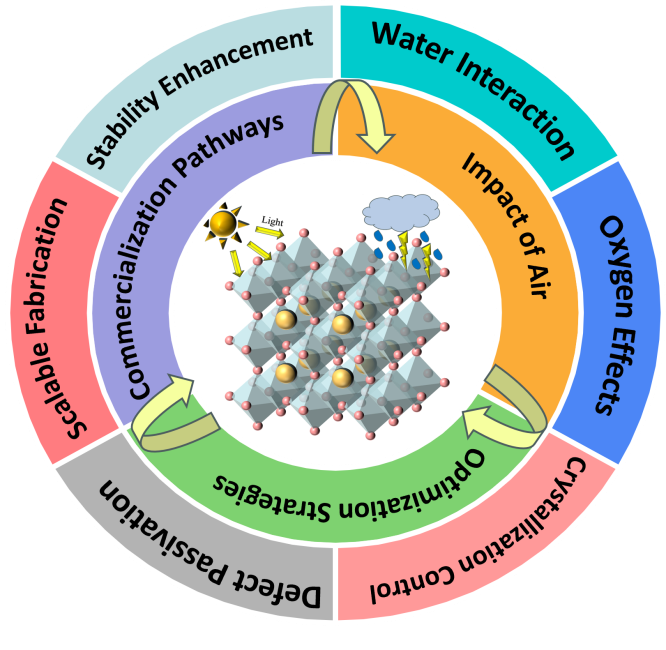
Perovskite solar cells (PSCs) have emerged as a disruptive photovoltaic technology due to their outstanding optoelectronic properties and the unique advantage of low-cost solution processing. Their fabrication requires a strictly inert atmosphere to prevent performance degradation. Therefore, achieving efficient, stable fabrication in ambient air is crucial for advancing the large-scale commercial application of this technology, as it can significantly reduce manufacturing costs, simplify process flows, and facilitate the implementation of scalable production techniques such as roll-to-roll printing. The primary challenges currently hindering ambient-air fabrication include material degradation induced by moisture, oxidation reactions triggered by oxygen, and humidity interference with crystallization kinetics. These issues often lead to reduced film quality and increased interfacial defects, thereby limiting device performance. Despite persistent challenges in moisture sensitivity, oxygen-induced degradation, and crystallization control, recent progress in ambient-air fabrication offers promising pathways for scalable, environmentally friendly production.
This review explores the impact of ambient air conditions on the formation of perovskite films, device performance, and stability. It summarizes research progress on strategies to address the above-mentioned challenges, including composition regulation, solvent optimization, and novel deposition techniques. Furthermore, the review analyzes technological advancements in ambient-air fabrication from lab-scale to large-scale production, with a focus on their potential for industrial translation. Finally, it outlines future research directions to enhance the efficiency, stability, and commercial viability of ambient-air fabricated PSCs, highlighting the technology's significant role in bolstering sustainable energy development.
Author Profiles

Xinyu Gu
2025 Ph.D. student in Professor Hao Chen's research team at the Global Institute of Future Technology, SJTU. Research areas: the development and application of efficient and stable single-junction perovskite photovoltaic devices. Gu has published two papers as the first author in journals, including Advanced Energy Materials and Green Energy & Environment.

Xiang Zhang
Postdoctoral researcher (supervisor: Hao Chen) at the Future Photovoltaics Research Center of the Global Institute of Future Technology, SJTU. He received a Ph.D. from the Institute of Technological Sciences, Wuhan University, and he has conducted postdoctoral research at Hong Kong Polytechnic University and the Global Institute of Future Technology, Shanghai Jiao Tong University. Research areas: the development of wide-bandgap perovskite solar cells and their application in tandem devices. Zhang has published more than 20 papers in renowned journals, including Adv. Mater., Adv. Energy Mater., and Adv. Funct. Mater., and holds two national patents.
Yixin Zhao
Chair Professor and Director of the Future Photovoltaics Research Center at the Global Institute of Future Technology, SJTU. Professor Zhao received his B.S./M.S. from Shanghai Jiao Tong University (2002/2005) and Ph.D. from Case Western Reserve University (2010), with postdoctoral experience at Penn State University and National Renewable Energy Laboratory. His honors include the National Young Talents Program, the Huo Yingdong Young Faculty Fund of the Ministry of Education, Shanghai Dawn Scholar Program, Shanghai Outstanding Young Academic Leader, and the National Science Fund for Distinguished Young Scholars. He has published over 200 papers in prestigious journals, including Science, Nat. Sustain., Sci. Adv., Nat. Commun., JACS, Angew. Chem., Chem. Soc. Rev., Joule, EES, and ES&T, with over 18,000 citations on Web of Science. He has been listed as a Clarivate Global Highly Cited Researcher for seven consecutive years since 2018. He also serves as an associate editor for the Journal of Energy Chemistry and as an editorial board member for several journals, including The Journal of Physical Chemistry Letters.

Hao Chen
Tenure-Track Associate Professor and Ph.D. supervisor at the Global Institute of Future Technology, SJTU. He was selected for the MIT Technology Review's "Innovators Under 35" Asia Pacific list in 2025 and has received support from the National High-Level Young Talents Program, the Shanghai Pujiang Program, and the inaugural Qiyuan Young Scholar Program. Professor Chen received his Ph.D. in 2020 from the University of Chinese Academy of Sciences - ShanghaiTech University (joint training), supervised by Professor Zhijun Ning. He served as a postdoctoral researcher at the University of Toronto and Northwestern University, USA, from 2021 to 2024, collaborating with Academician Edward Hartley Sargent. His research focuses on the development and application of efficient and stable single/multi-junction perovskite photovoltaic devices. He has set multiple world records for the certified efficiency of perovskite photovoltaic devices, frequently appearing on authoritative international charts of the world's highest solar cell efficiencies. He was also the first one to achieve certified efficiencies for inverted-structure perovskite photovoltaic devices, surpassing those of conventional n-i-p structures. Professor Chen has published multiple papers as the first author (including co-first author) or corresponding author in top journals such as Science (3), Nature (3), Nat. Photonics, Nat. Mater., Nat. Energy, and Nat. Nanotechnol. He serves as a youth editorial board member for Nano-Micro Letters, InfoMat, eScience, and Materials Today Electronics. He is a long-term reviewer for over 20 journals, including Nature Energy, Nature Photonics, JACS, and Advanced Materials.