GIFT Postdoctoral Researcher Yu Zou Publishes News & Views Article in Nature Materials as First Author: Reconfiguring Perovskite Interlayers
A research team led by Professor Yixin Zhao from the Future Photovoltaics Research Center at the Global Institute of Future Technology, SJTU, has published a News & Views article titled "Reconfiguring perovskite interlayers" in the top-tier international materials science journal Nature Materials. Postdoctoral researcher Yu Zou from Professor Yixin Zhao's team is the first author, with Professor Yixin Zhao as the corresponding author.
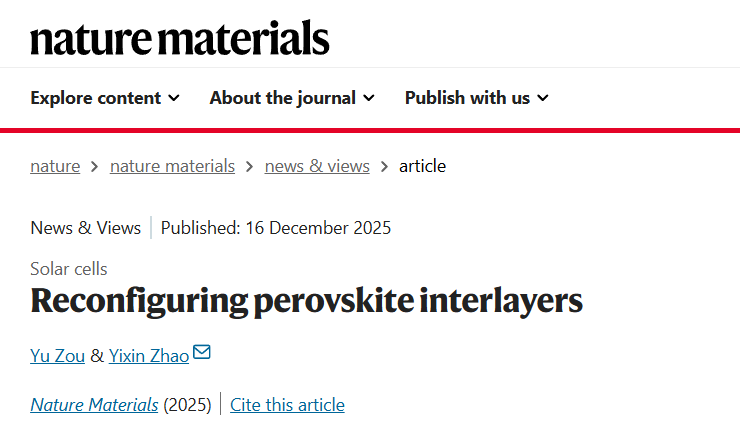

The construction of traditional covalently bonded semiconductor heterojunctions is constrained by strict requirements for lattice matching and interfacial chemical bonding, often relying on high-precision epitaxial growth or material-transfer technology. This limitation hinders material integration and large-scale applications in certain scenarios. In contrast, solution-processing technology enables the flexible integration of diverse functional materials on hybrid semiconductor surfaces via non-covalent interactions, such as ionic bonds and Van der Waals forces, significantly expanding the research boundaries and enhancing design flexibility for heterostructures. As one of its core applications, the optoelectronic performance of perovskite semiconductor heterojunctions is often limited by disordered interfacial contacts. Weak intermolecular interactions and interfacial constraints are likely to cause chaotic molecular stacking and significant interfacial defects, resulting in severe carrier recombination losses and posing a critical bottleneck to strengthening device performance. Therefore, a central challenge in enhancing the optoelectronic performance and stability of perovskite heterojunctions lies in achieving ordered, uniform interlayer construction at the molecular scale while maintaining the simplicity and flexibility of solution processing.
Recent research has revealed the diverse chemical states on polycrystalline perovskite film surfaces, including multiple types of terminal groups and the coexistence of defect sites such as grain boundaries. This complexity leads to non-uniform distribution and disordered stacking of deposited fullerene transport materials. Thus, the above-mentioned study proposes a small-molecule-assisted co-deposition strategy to in situ construct an ultra-thin interlayer on the perovskite surface. This approach effectively shields the complex surface chemistry of the polycrystalline perovskite film and provides uniform anchoring sites for the subsequent deposition of organic transport materials, thereby achieving a regularized reconfiguration of interfacial molecular interactions and stacking modes from "disordered" to "ordered." This research highlights the critical impact of molecular-scale order on interfacial properties, offering a new paradigm for the design and integration of optoelectronic functional materials and devices based on complex heterogeneous interfaces. Precise modulation of heterojunction interface properties through non-covalent interactions is poised to become an important pathway for future breakthroughs in the performance and scalable application of hybrid semiconductor optoelectronic devices, providing new impetus for technological innovation in the new energy sector.
Paper Title:
Yu Zou, Yixin Zhao. Reconfiguring perovskite interlayers. Nat. Mater. (2025).
Paper Link:
https://doi.org/10.1038/s41563-025-02438-w
Author Profile
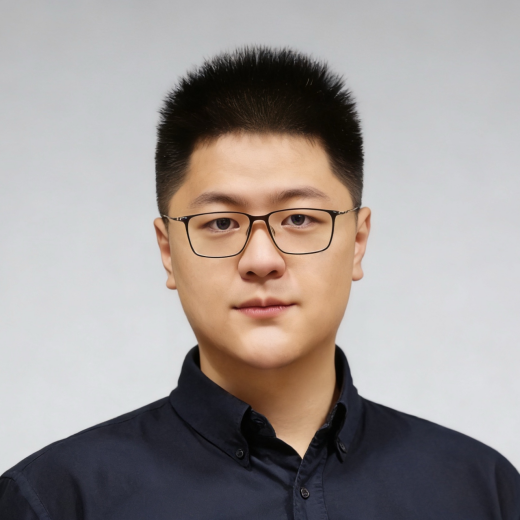
Yu Zou
Postdoctoral Researcher (supervisor: Professor Yixin Zhao) at the Future Photovoltaics Research Center of the Global Institute of Future Technology, SJTU. He received his Bachelor's (2019) and Ph.D. (2024) degrees from Peking University, and then joined GIFT for postdoctoral research. His research focuses on the physical properties of perovskite materials and their applications in energy-related optoelectronics. He has published over 10 papers as the first or corresponding author (including co-authors) in prestigious journals such as Science, Nature, Nat. Mater., Nat. Rev. Mater., Chem. Soc. Rev., Nano Lett., and Appl. Phys. Lett., including 2 ESI Highly Cited Papers and 1 ESI Hot Paper. He has obtained multiple research grants, including the National Natural Science Foundation of China (Youth Program), the National Postdoctoral Fellowship Program of CPSF, the China Postdoctoral Science Foundation (General Program), and the Shanghai Super Postdoctoral Program.