Professor Yabing Qi Publishes in Nature Communications: Light-Oxidation Doping Technology Enhances Efficiency and Stability of Perovskite Photovoltaic Devices
In November 2025, Professor Yabing Qi from Global Institute of Future Technology and Zhangjiang Institute for Advanced Study in Shanghai Jiao Tong University, in collaboration with researchers from Okinawa Institute of Science and Technology Graduate University (OIST) and Hefei University of Technology, achieved a significant breakthrough in perovskite solar cells. The research paper titled "Synergistic versatile bistriflimide salts in light-accelerated spiro-OMeTAD oxidation and perovskite module photovoltaics engineering" was published in Nature Communications. This research provides a crucial solution to the existing challenges of the hole transport layer (HTL) in perovskite solar cells.

In n-i-p structured perovskite solar cells, spiro-OMeTAD has been the most widely used material for the hole transport layer due to its suitable energy level matching and excellent film-forming properties. However, the conventional doping recipe (using LiTFSI as the dopant and tBP as the additive) faces three major bottlenecks: 1) the migration of lithium ions accelerates device degradation, leading to poor operational stability; 2) the reliance on oxygen in the air for the spiro-OMeTAD doping hinders precise control of doping levels; 3) the strong corrosiveness of tBP damages the surface of perovskites, exacerbating interfacial charge recombination. These issues pose a significant obstacle to commercialization and practical application of perovskite solar cell devices.
To address these challenges, this research proposed a "Light Oxidation Doping Treatment (LODT in short)" strategy that utilized light to generate protons in the precursor solution by ammonium salt TFSI dopants, which in turn enabled efficient oxidation of spiro-OMeTAD, significantly increased the conductivity of the hole transport layer. The technology uses THF to partially replace the corrosive tBP, solving the solubility issue of ammonium salts while avoiding the damage to the perovskite layer caused by the conventional solvent. Moreover, the researchers introduced a "dual TFSI additive synergistic" system: first, the potassium TFSI (KTFSI) was incorporated into the perovskite precursor solution to regulate crystallization, increasing grain size from below 500 nm to over 1 μm and reducing the density of electron and hole defect states; second, octylammonium (OA) TFSI (OATFSI) is employed to form a thermally stable 2D perovskite layer via passivation, which increases the water contact angle from 2.9° to 66.1°, thus enhancing the device's resistance to humidity.
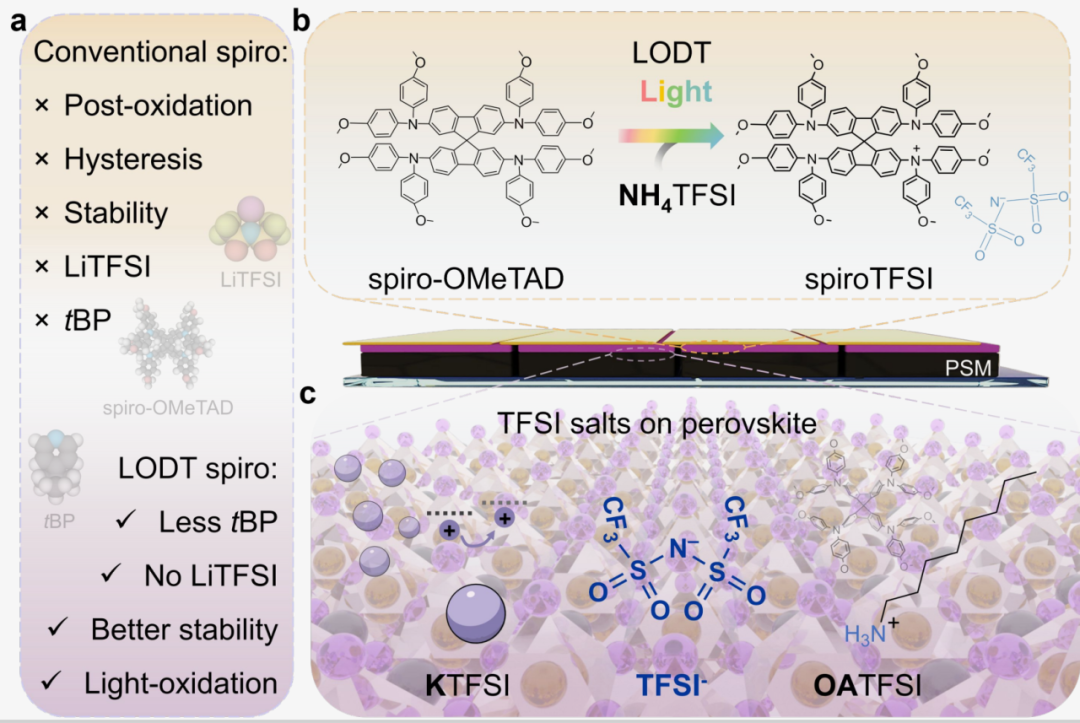
Figure 1 - Schematic diagram of the Light-Oxidation Doping Treatment (LODT) and the synergistic regulation of perovskite solar cell devices by TFSI salts
Through this optimized strategy, the perovskite solar cell modules (PSM) developed by the researchers achieved a certified power conversion efficiency of 20.95% for an aperture area of 12.83 cm², ranking among the top-tier for Li-free spiro-OMeTAD HTL perovskite solar modules. Notably, the unencapsulated small-area PSMs retained 97% of their initial efficiency after continuous operation for 700 hours in dry N2 environment. Encapsulated devices maintained a T90 operational stability of 491 hours at 45°C, and a T75 operational stability of 500 hours at 65°C, mitigating the long-standing challenge of balancing efficiency and stability. Furthermore, this strategy incorporates scalable fabrication processes such as blade coating, which minimizes efficiency loss during module scaling, demonstrating strong potential for industrial application.
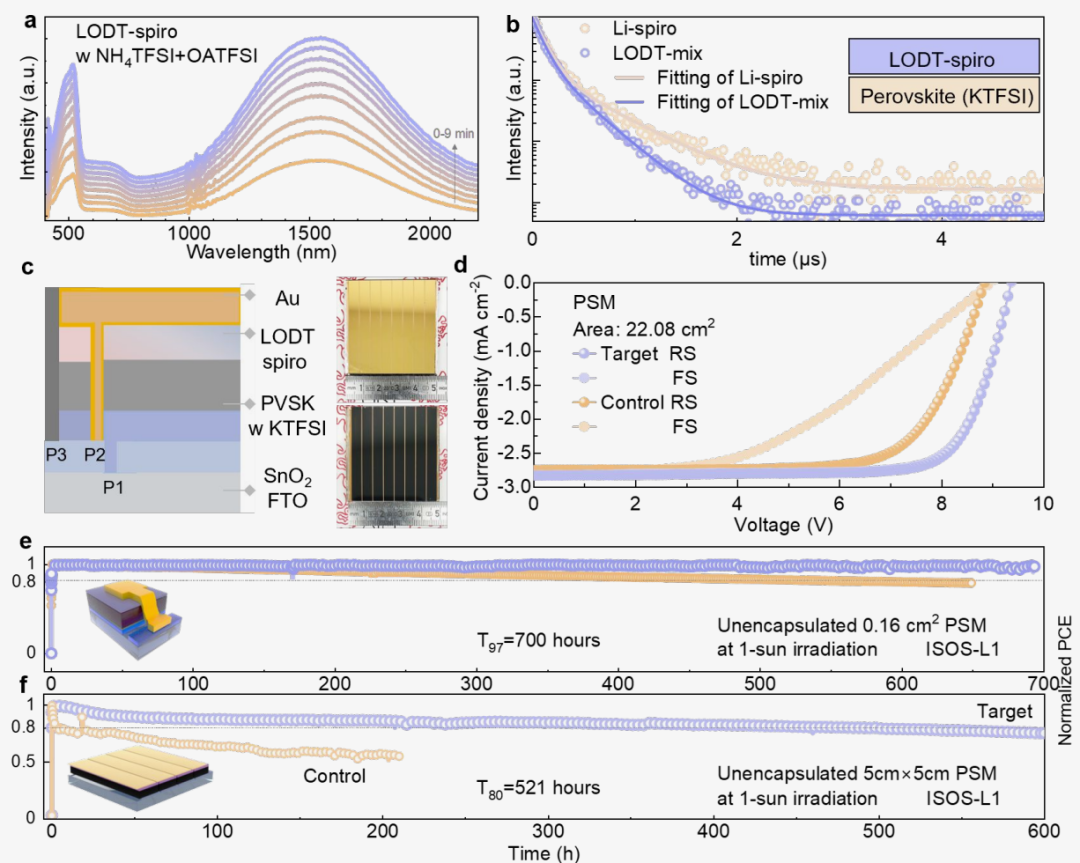
Figure 2 - Experimental results on the performance and stability of PSMs based on the LODT strategy
Dr. Jiahao Zhang from OIST is the first author of the paper. Professor Yabing Qi from Global Institute of Future Technology / Zhangjiang Institute for Advanced Study in Shanghai Jiao Tong University, Dr. Luis K. Ono from OIST, and Professor Guoqing Tong from Hefei University of Technology are the corresponding authors. This research received support from Global Institute of Future Technology and Zhangjiang Institute of Advanced Study in Shanghai Jiao Tong University, and OIST, etc.
Paper Link: https://www.nature.com/articles/s41467-025-66752-2
Professor Profile
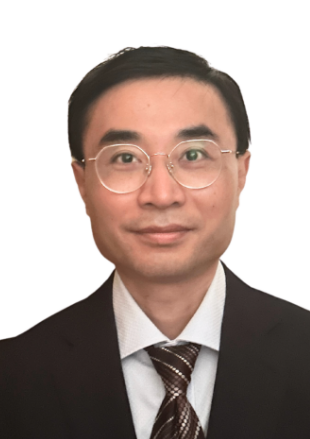
Yabing Qi
Yabing Qi is a Distinguished Professor at Global Institute of Future Technology / Zhangjiang Institute of Advanced Study in Shanghai Jiao Tong University, and a Foreign Fellow of the Engineering Academy of Japan. Prof. Qi obtained his B.Sc., M.Phil., and his Ph.D. degrees from Nanjing University, Hong Kong University of Science and Technology, and University of California Berkeley, respectively. From 2008 to 2011, he conducted postdoctoral research at Princeton University. From 2011 to 2024, he was a faculty member at the Okinawa Institute of Science and Technology Graduate University (OIST) in Japan, where he had an early promotion to tenured Full Professor, leading the Energy Materials and Surface Sciences Unit as Unit Head. In 2024, Prof. Qi joined Shanghai Jiao Tong University as a full-time Distinguished Professor.
Over the past two decades, Prof. Qi has made outstanding contributions to surface science and energy materials. In 2022, he received the Kao Science Award from the Kao Foundation for Arts and Sciences in Japan. In 2023, he received the JSPS Prize. In 2024, he was elected as a Foreign Fellow of the Engineering Academy of Japan.
As a distinguished scholar in the fields of surface sciences and energy materials, Prof. Qi has published over 200 SCI-indexed papers in internationally renowned academic journals. He has an H-index of 86 and total citations exceeding 30,000. Since 2021, he has been selected as a Clarivate "Highly Cited Researcher" for five consecutively years. He is also a Fellow of the Materials Research Society (MRS Fellow), a Fellow of the American Vacuum Society (AVS Fellow), and a Fellow of the Royal Society of Chemistry (FRSC).
Prof. Qi's research spans multiple disciplines including materials science, physics, chemistry, and electrical engineering. He plans to establish an internationally competitive multidisciplinary research center for surface sciences and advanced materials at Shanghai Jiao Tong University, applying fundamental surface science research to the development of energy and functional materials and devices, such as solar cells, lithium-ion batteries, organic electronic devices and light emitting materials, providing crucial technical support for the future development of energy technologies.