GIFT Center for Brain Health and Brain Technologies Publishes in PNAS: Unveiling Inhibitory Neuron Engrams for Fear Extinction
Fear memory helps organisms to avoid danger, but in disorders like post-traumatic stress disorder (PTSD), pathological fear memories can persist for a long time, severely impacting patients' lives. While exposure therapy, a common clinical approach, forms a new "safety memory" by repeatedly presenting fear-inducing stimuli in a safe context to suppress the original fear response, the mechanisms that control the competing extinction and fear memories in the basolateral amygdala (BLA) are not yet fully understood.
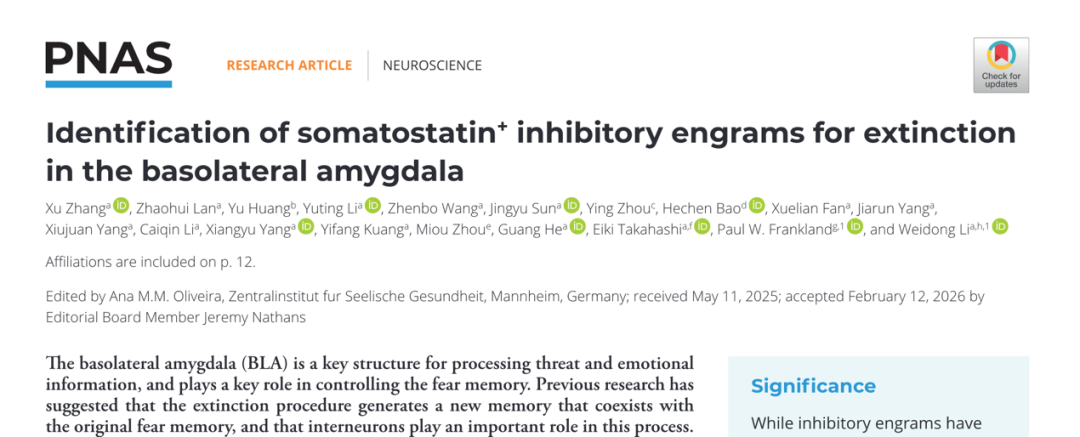
On March 20, 2026, researchers from the Global Institute of Future Technology and the Bio-X Institute, SJTU, along with other collaborators, published a paper in Proceedings of the National Academy of Sciences (PNAS) titled "Identification of somatostatin+ inhibitory engrams for extinction in the basolateral amygdala." The study provides the first evidence that somatostatin (SST)-expressing inhibitory neurons in the BLA constitute an "inhibitory engram" for fear extinction. The finding reveals a key neural circuit mechanism through which the brain suppresses fear memories and identifies a potential therapeutic target for PTSD and related disorders.
After a decade of technical innovation, the research team developed a novel chemogenetic strategy that offers improved sensitivity and specificity for tagging neurons during defined behavioral epochs. This strategy allows precise, cell-type-specific targeting of GABAergic inhibitory neurons in the BLA while simultaneously tagging only those neurons activated during fear extinction learning. In other words, it provides a molecular "identification" for the specific inhibitory cells involved in extinction, enabling precise manipulation of the complex neural circuitry afterward.

Figure: Specifically silencing of BLA extinction-tagged GABAergic neurons impairs extinction retrieval.
Dr. Xu Zhang from the Bio-X Institute is the first author. The Supervisor Dr. Weidong Li (Director of the Center for Brain Health and Brain Technologies, GIFT) and Visiting Professor Paul Frankland (University of Toronto, Canada) served as co-corresponding authors. The research was supported by STI2030-Major Projects, the National Natural Science Foundation of China, Science and Technology Commission of Shanghai Municipality Program, and the “111” Project of Higher Education Discipline Innovation, etc.
Paper Link: