GIFT Professor Yixin Zhao's Team Publishes Paper in Advanced Materials
A team from the Future Photovoltaics Research Center at the Global Institute of Future Technology has published a paper in Advanced Materials, a top-tier international journal in materials sciences. The paper titled “Differential Ligand-Cation Interactions Enable 2D-Template-Induced Ordered Assembly for Efficient Tin-Based Perovskite Photovoltaics” introduces a novel differential ligand-cation interaction strategy, which decouples the crystallization of 2D and 3D phases, enabling the 2D phase to template the ordered growth of the 3D phase and achieves a significant advancement in the efficiency and stability of tin-based halide perovskite (THP) solar cells. GIFT Postdoctoral researcher Yu Zou, doctoral student Jian Liu, and SJTU Global College doctoral student Yide Chang are co-first authors of the paper. GIFT Professor Yixin Zhao, Assistant Research Professor Yao Wang, Associate Professor Yanming Wang, and Research Professor Chenghao Duan from Henan University are co-corresponding authors. The work is supported by the National Natural Science Foundation of China, the Shanghai Science and Technology Innovation Action Plan, and the China Postdoctoral Science Foundation, etc.
The fabrication of high-quality tin-based perovskite films faces two major challenges: rapid oxidation of Sn²⁺ and uncontrollable, rapid crystallization, which typically lead to defective and unstable films. Incorporating more stable and uniformly oriented 2D phase components into the fast-crystallizing and oxidation-prone 3D phases as growth templates is a common strategy. However, simultaneous crystallization of the 2D phase with the 3D phase greatly undermines ordered crystallization in high-performance THP devices. Moreover, the inhomogeneous spatial distribution of 2D/3D components hinders efficient charge carrier transport and film stability.
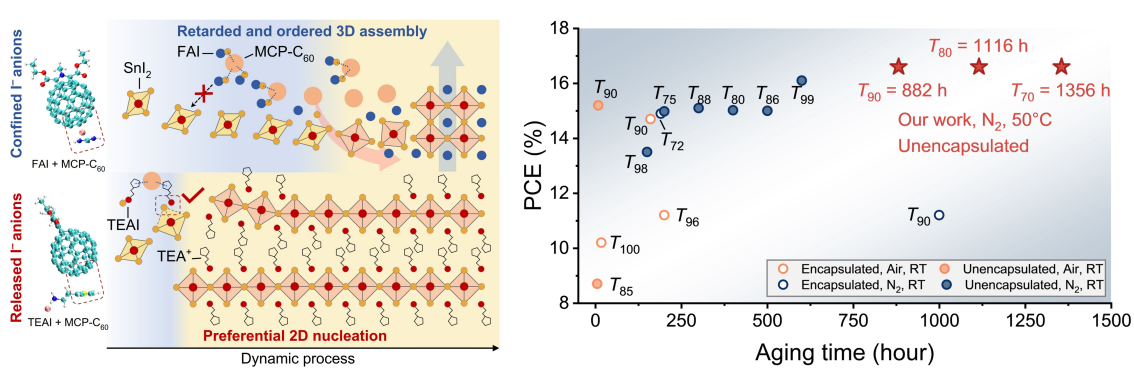
To address this challenge, the research team introduced a novel ligand-cation interaction strategy. By precisely tailoring interactions between the different dimensional phase components and ligand molecules, they successfully decoupled the crystallization processes of the 2D and 3D phases. This enabled preferential nucleation of the 2D phase as a template, which in turn guided the ordered growth of the 3D phase. The THP films fabricated using this strategy exhibit high quality and strong orientation, forming a uniform and stable 2D/3D bulk hetero-structure. As a result, the THP photovoltaic devices achieved a state-of-the-art power conversion efficiency of 16.6%. Moreover, unencapsulated devices operating at maximum power point under continuous 1-sun illumination and 50°C exhibit a nine-fold longer T90 lifetime (882 h vs. 99 h) compared to control devices.
This study elucidates an important mechanism for regulating crystallization kinetics by precisely controlling intermolecular interactions and enabling ordered assembly of bulk crystals templated by low-dimensional phases. It provides a novel approach to developing THP materials and their application in new clean energy technologies.
Paper Link:
Differential Ligand–Cation Interactions Enable 2D-Template-Induced Ordered Assembly for Efficient Tin-Based Perovskite Photovoltaics. Adv. Mater., 2026, 38, e22717.
https://doi.org/10.1002/adma.202522717
Author Profiles

Yu Zou
Postdoctoral Researcher (supervisor: Professor Yixin Zhao) at the Future Photovoltaics Research Center of the Global Institute of Future Technology, SJTU. He received his Bachelor's (2019) and Ph.D. (2024) degrees from Peking University. His research focuses on the physical properties of perovskite materials and their applications in energy-related optoelectronics. He has published over 10 papers as the first or corresponding author (including co-authors) in prestigious journals such as Science, Nature, Nat. Mater., Nat. Rev. Mater., Chem. Soc. Rev., Nano Lett., and Appl. Phys. Lett., including 2 ESI Highly Cited Papers and 1 ESI Hot Paper. He has obtained multiple research grants, including the National Natural Science Foundation of China (Youth Program), the National Postdoctoral Fellowship Program of CPSF, the China Postdoctoral Science Foundation (General Program), and the Shanghai Super Postdoctoral Program.

Yanming Wang
Associate Professor and Executive Director of the Future Photovoltaics Research Center. He received his Ph.D. from Stanford University and conducted postdoctoral research at MIT. His research focuses on multiscale simulation and AI for advanced energy materials, with over 60 publications in journals such as Science and Nature Communications. He also serves as a member of the youth editorial board of the Journal of Energy Chemistry.

Yao Wang
Assistant Research Professor at the Future Photovoltaics Research Center. He received his Ph.D. from the Institute of Functional Nano & Soft Materials (FUNSOM) at Soochow University and conducted postdoctoral research at SJTU. His research focuses on the development and application of high-performance perovskite solar cells, and he has published over 30 papers in journals, including Nature, Joule, Adv. Mater., JACS, and Angew. Chem.

Yixin Zhao
Chair Professor and Director of the Future Photovoltaics Research Center. Professor Zhao received his B.S./M.S. from Shanghai Jiao Tong University (2002/2005) and Ph.D. from Case Western Reserve University (2010), with postdoctoral experience at Penn State University and National Renewable Energy Laboratory. His honors include the National Young Talents Program, Fok Ying-Tong Education Fund of China, Shanghai Dawn Scholar Program, Shanghai Outstanding Young Academic Leader, National Science Fund for Distinguished Young Scholar, first place in the Shanghai Natural Science Award, and Qingshan Science and Technology Award. He has published over 200 papers in prestigious journals, including Science, Nat. Sustain., Sci. Adv., Nat. Commun., JACS, Angew. Chem., Chem. Soc. Rev., Joule, EES, and ES&T, with over 25,000 citations. He has been listed as a Clarivate Global Highly Cited Researcher for eight consecutive years since 2018. He also serves as an associate editor for the Journal of Physical Chemistry Letters and as an editorial board member for several journals, including National Science Review, eScience, and Science Bulletin.