GIFT Hao Chen's Team Publishes in JACS: Homogenizing Perovskite Optoelectronic Properties with Common Chloride Additives for High-Efficiency Solar Cells
A research team led by Associate Professor Hao Chen from the Future Photovoltaics Research Center at the Global Institute of Future Technology, in collaboration with the University of Oxford, Kyoto University, and ShanghaiTech University, has published a paper titled "Homogenized Optoelectronic Properties in Perovskites: Achieving High-Efficiency Solar Cells with Common Chloride Additives" in Journal of the American Chemical Society (JACS). The corresponding authors are Associate Professor Hao Chen (GIFT), Professor Henry J. Snaith (University of Oxford), Professor Atsushi Wakamiya (Kyoto University), and Professor Zhijun Ning (ShanghaiTech University). Xinyu Gu, a 2025 doctoral student in Hao Chen's team, is a co-first author.

Improving the bulk quality of perovskite films is crucial for achieving high-performance photovoltaic devices. Chlorine-containing additives, such as lead chloride (PbCl₂) and methylammonium chloride (MACl), are widely used in perovskite photovoltaics to regulate crystallization kinetics and grain morphology. However, the specific effects of different chloride additives on nanoscale phase homogeneity and luminescence uniformity have not been thoroughly investigated.

Figure 1: Phase distribution and nanoscopic emission of perovskite films
This study offers new insights into how the selection and combination of chloride additives affect phase transitions and spatially uniform carrier dynamics in perovskite films. The research demonstrates that the strategic combination of MACl and PbCl₂ enhances crystallinity and optoelectronic uniformity across both micrometer and millimeter scales.
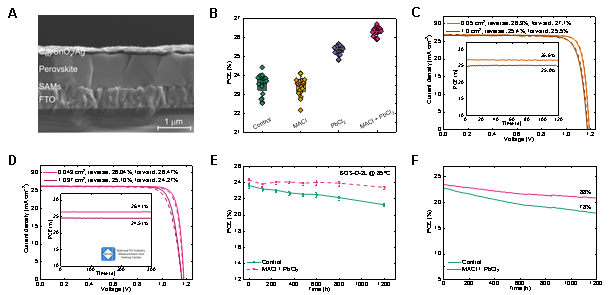
Figure 2: Photovoltaic and stability performance of PSCs
Based on these findings, the team fabricated inverted (p-i-n) perovskite solar cells that achieved certified quasi-steady-state efficiencies of 26.4% and 24.5% at device areas of 0.05 and 1 cm2, respectively. These devices also exhibit robust operational stability, retaining 88% of their initial performance after 1200 hours of continuous maximum power point tracking at an elevated temperature of 65°C under simulated AM1.5G illumination. This research elucidates the mechanistic differences among various chloride additives, providing a feasible strategy to advance large-area, high-efficiency, and thermally stable perovskite photovoltaic technology.
Paper Link:
https://pubs.acs.org/doi/10.1021/jacs.5c18303
Author Profiles

Xinyu Gu
Xinyu Gu is a 2025 doctoral student in Associate Professor Hao Chen's research team. His research focuses on the development of efficient and stable single-junction perovskite photovoltaic devices. He has published three papers as first author (including co-first author) in journals, including Journal of the American Chemical Society (JACS), Advanced Energy Materials (AEM), and Green Energy & Environment (GEE).

Hao Chen
Hao Chen is an Associate Professor and doctoral supervisor at the Global Institute of Future Technology. He has been recognized as a National-Level Young Talent (Overseas, 2024), a Shanghai High-Level Young Talent (2024), and a Qiyuan Young Scholar (2025). He was named to the MIT Technology Review "Innovators Under 35" Asia Pacific list and received the "Frontiers in Energy Rising Scientist Award." Prof. Chen earned his PhD in 2020 from the University of Chinese Academy of Sciences and ShanghaiTech University (joint program) under the supervision of Professor Zhijun Ning. From 2021 to 2024, he conducted postdoctoral research at the University of Toronto and Northwestern University, collaborating with Academician Edward H. Sargent. His research focuses on the development of efficient and stable single-/multi- junction perovskite photovoltaic devices. He has set multiple world records for perovskite photovoltaic efficiency, and has frequently appeared on global solar cell efficiency charts, and was the first to achieve certified inverted perovskite device efficiency. He has published numerous papers as first author, co-first author and corresponding author in leading journals, including Science (3), Nature (3), Nature Photonics, Nature Materials, Nature Energy, Nature Nanotechnology, JACS, and Advanced Materials (4). Fifteen of his papers are ESI Highly Cited Papers, with over 7,700 citations. He also serves as a youth editorial board member for Nano-Micro Letters, InfoMat, eScience, and Materials Today Electronics, and regularly reviews for more than 20 journals, including Science, Nature Energy, Nature Photonics, JACS, and Advanced Materials.